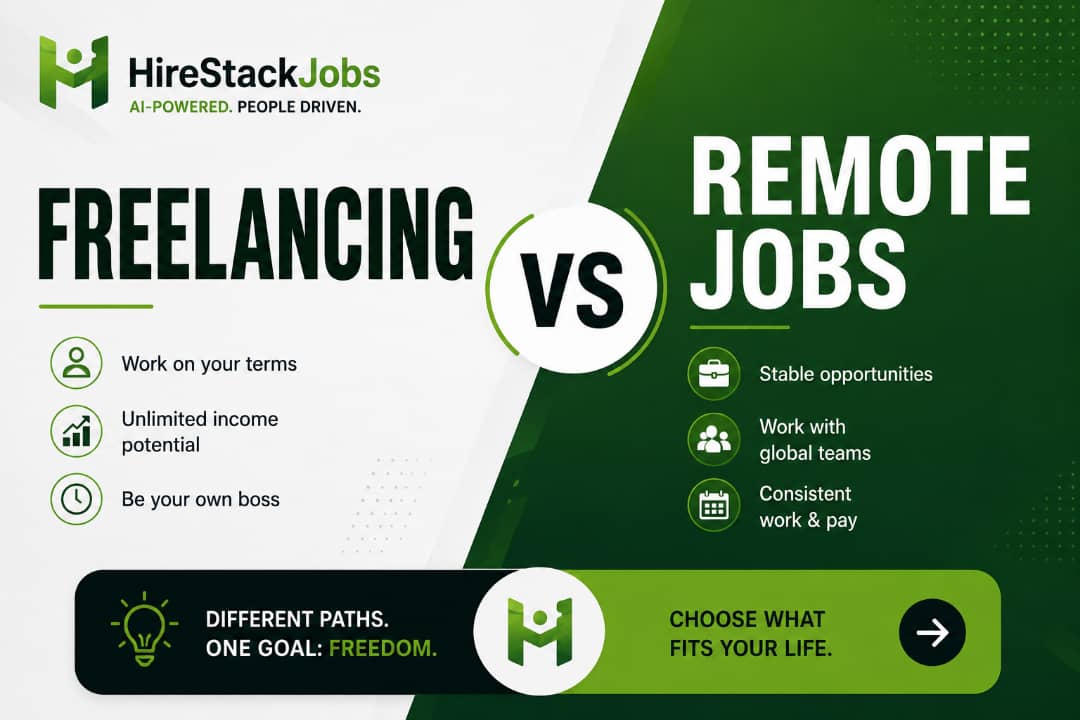
Freelancing vs Remote Jobs: Which One Is Better in 2026?
The internet has created more ways to earn a living than ever before. Whether you're a student, graduate, stay-at-home parent, or experienced professional, you've probably come across two popular terms: freelancing and remote jobs.
Many people use these terms interchangeably, but they're not the same.
Understanding the difference can help you choose the career path that best suits your goals, lifestyle, and income expectations.
In this guide, we'll explain the key differences, the benefits of each, and how platforms like Hirestackjobs are making remote work more accessible through an AI-powered marketplace.
What Is Freelancing?
Freelancing means working independently for different clients instead of being employed by a single company.
Freelancers usually find work through marketplaces or direct client relationships.
Examples include:
- Graphic Design
- Web Development
- Content Writing
- Video Editing
- Digital Marketing
- Translation
- Virtual Assistance
Freelancers are responsible for finding clients, negotiating prices, delivering projects, and managing their own business.
What Is a Remote Job?
A remote job simply means you work from a location outside a traditional office.
Remote workers may:
- Work full-time.
- Work part-time.
- Complete short-term projects.
- Perform AI microtasks.
- Assist businesses with digital operations.
Unlike freelancing, many remote workers follow company guidelines and complete assigned tasks instead of constantly searching for clients.
The Biggest Difference
The biggest difference is simple:
Freelancers look for clients.
Remote workers look for opportunities.
Freelancers operate like business owners.
Remote workers operate like professionals working digitally.
Both can earn excellent incomes, but the experience is very different.
How Freelancers Earn
Freelancers usually charge:
Per hour
Per project
Monthly retainers
Service packages
Income depends on:
Experience
Reputation
Marketing
Negotiation skills
Client relationships
How Remote Workers Earn
Remote workers generally earn by:
Completing assigned projects
Finishing approved tasks
Working hourly
Meeting company targets
Participating in AI-related projects
Payment methods vary depending on the employer or platform.
Advantages of Freelancing
Freelancing offers many benefits.
Complete Freedom
You decide:
Who you work with
Your schedule
Your pricing
Your services
Unlimited Income Potential
There is no salary cap.
Successful freelancers often earn more as they build their reputation.
Personal Brand
Freelancers build their own businesses and long-term client relationships.
Challenges of Freelancing
Freelancing also comes with challenges.
You must:
Find clients regularly.
Handle contracts.
Send invoices.
Market yourself.
Deal with inconsistent income.
Many beginners struggle to secure their first clients.
Advantages of Remote Jobs
Remote jobs provide greater stability.
Workers often receive:
Regular projects
Structured workflows
Clear instructions
Predictable payments
Long-term opportunities
This makes remote work attractive for people who prefer consistency.
Why AI Is Changing Both Industries
Artificial intelligence is transforming both freelancing and remote work.
Businesses increasingly hire people for:
AI Data Annotation
AI Response Evaluation
AI Prompt Testing
Research
Content Moderation
Data Collection
These opportunities are creating new career paths that didn't exist just a few years ago.
Which Option Is Better?
The answer depends on your goals.
Choose freelancing if you:
Enjoy entrepreneurship.
Want unlimited earning potential.
Like finding your own clients.
Want complete independence.
Choose remote work if you:
Prefer structured opportunities.
Want consistent workflows.
Enjoy teamwork.
Want to focus on completing tasks rather than selling your services.
Many professionals actually combine both.
They maintain remote jobs while freelancing during their free time.
How Hirestackjobs Bridges the Gap
Hirestackjobs is an emerging AI-powered peer-to-peer remote work marketplace that combines the flexibility of freelancing with the simplicity of remote work.
Instead of limiting businesses to traditional hiring methods, Hirestackjobs enables organizations to post digital projects while verified workers discover opportunities that match their skills.
Businesses can outsource:
AI Data Annotation
Research
Surveys
Content Moderation
Data Collection
AI Evaluation
Digital Projects
Workers can build professional profiles, verify their accounts, complete projects, and grow their digital careers—all from a single platform.
This flexible approach allows businesses to scale efficiently while giving workers access to meaningful opportunities.
The Future of Digital Work
Remote work and freelancing are no longer competing models—they're complementary.
As businesses continue embracing global talent and AI-powered operations, professionals who can adapt to different work styles will have the greatest opportunities.
Whether you choose freelancing, remote work, or a combination of both, success depends on continuously learning, delivering quality work, and building trust.
Final Thoughts
The digital economy offers more opportunities than ever before.
Freelancing gives you the freedom to build your own business, while remote jobs provide structure, flexibility, and access to global employers.
As AI continues to reshape the workplace, both paths are expected to grow.
By developing valuable skills and embracing new technologies, you can build a rewarding career regardless of which option you choose.
Platforms like Hirestackjobs are helping make this future more accessible by connecting businesses with verified workers through an AI-powered remote work marketplace.
Frequently Asked Questions (FAQs)
Is freelancing better than remote work?
Neither is universally better. Freelancing offers more independence, while remote work often provides more structure and consistency.
Can I do both?
Yes. Many professionals work remotely while also freelancing in their spare time.
Which option is better for beginners?
Remote work is often easier for beginners because it provides clearer workflows and doesn't require finding clients independently.
Is AI creating new opportunities for freelancers and remote workers?
Yes. AI has increased demand for roles such as data annotation, prompt evaluation, research, content moderation, and AI quality assurance.